
Earnie

Four datasets. One policy manager. Every surface.

Earnie identifies what's really inside your code, no matter who (or what) wrote it. Then, whenever code enters, Earnie checks every snippet against your set policy, and records every decision.

How Earnie works: Data, Policy, Surfaces, RecordCode from humans, open source and AI agents enters a single line through four steps. Data: What's really in the code, matched against the knowledge base. Policy: Your rules, set once per project, in clicks or code. Surfaces: Checked in the agent's session, at the keyboard, at merge and in the browser. Record: Every finding, decision and fix, versioned and on demand. The line ends at the record. Each step links to its section below.HumansOpen sourceAI agentsDataWhat's really in thecode, matched againstthe knowledge base.PolicyYour rules, set onceper project, in clicksor code.SurfacesChecked in the agent'ssession, at thekeyboard, at merge andin the browser.RecordEvery finding, decisionand fix, versioned andon demand.How Earnie works: Data, Policy, Surfaces, RecordCode from humans, open source and AI agents enters a single line through four steps. Data: What's really in the code, matched against the knowledge base. Policy: Your rules, set once per project, in clicks or code. Surfaces: Checked in the agent's session, at the keyboard, at merge and in the browser. Record: Every finding, decision and fix, versioned and on demand. The line ends at the record. Each step links to its section below.HumansOpen sourceAI agentsDataWhat's really in the code, matchedagainst the knowledge base.PolicyYour rules, set once per project, inclicks or code.SurfacesChecked in the agent's session, atthe keyboard, at merge and in thebrowser.RecordEvery finding, decision and fix,versioned and on demand.

We don't read the label. We read the code.

Earnie is new, but the knowledge base is not. Policy, surfaces and record are built for code written by humans and agents alike. Underneath sits a proven knowledge base and an improved matching engine.

Meet the team behind Earnie →

188M+
Open source components
3T
Lines of code fingerprinted
120+
Cryptographic algorithms detected
150+
AI/ML packages recognised
12
Programming languages scanned
12
AI model file formats: Safetensors, GGUF, ONNX, PyTorch and more

Four datasets. Each one held to your policy.

AI models

Detection over declaration. AI SDKs, model files and API keys found, matched against known models and held to your policy. Documented in an AIBOM with provenance and licence. What's really there, in writing.

Cryptography & PQC

Every cryptographic algorithm in your estate, inventoried and checked against policy, with flags on what won't survive the post-quantum transition. The migration starts with an inventory. Earnie keeps it standing.

OSS licence compliance

Components, licences, obligations, down to the snippet someone pasted. Policy applied before it ships. Attribution and notice files generated, SBOMs versioned and retrievable. The record, ready before anyone asks.

Security vulnerabilities

Known vulnerabilities in what you actually ship, found where they live, tied to remediation at AI speed. The fix arrives with the finding, usually one click away.

Four datasets, one policyFour datasets, Open source components, AI models, Cryptography & PQC, Security vulnerabilities, all feed into one node: your policy, which decides what is allowed, what warns and what blocks. From it comes one record: SBOM, AIBOM, CBOM, Notice files, Evidence, linked to source.Open source componentsAI modelsCryptography & PQCSecurity vulnerabilitiesSBOMAIBOMCBOMNotice filesEvidence, linked to sourceYour policyAllowWarnBlockFour datasets, one policyFour datasets, Open source components, AI models, Cryptography & PQC, Security vulnerabilities, all feed into one node: your policy, which decides what is allowed, what warns and what blocks. From it comes one record: SBOM, AIBOM, CBOM, Notice files, Evidence, linked to source.Open source componentsAI modelsCryptography & PQCSecurity vulnerabilitiesSBOMAIBOMCBOMNotice filesEvidence, linked to sourceYour policyAllowWarnBlock

Your rules. Written once. Checked everywhere.

Findings on their own are a to-do list. Policy decides what happens to them: what's allowed, what warns, what blocks.

Request a demo

Policies in clicks or code.

Central policies across licence, crypto, AI and security, expressed in CEL and compatible with the policy systems you already run. Build them point-and-click, the way you'd build an advanced search, or manage them through the API and MCP. Natural language is coming next.
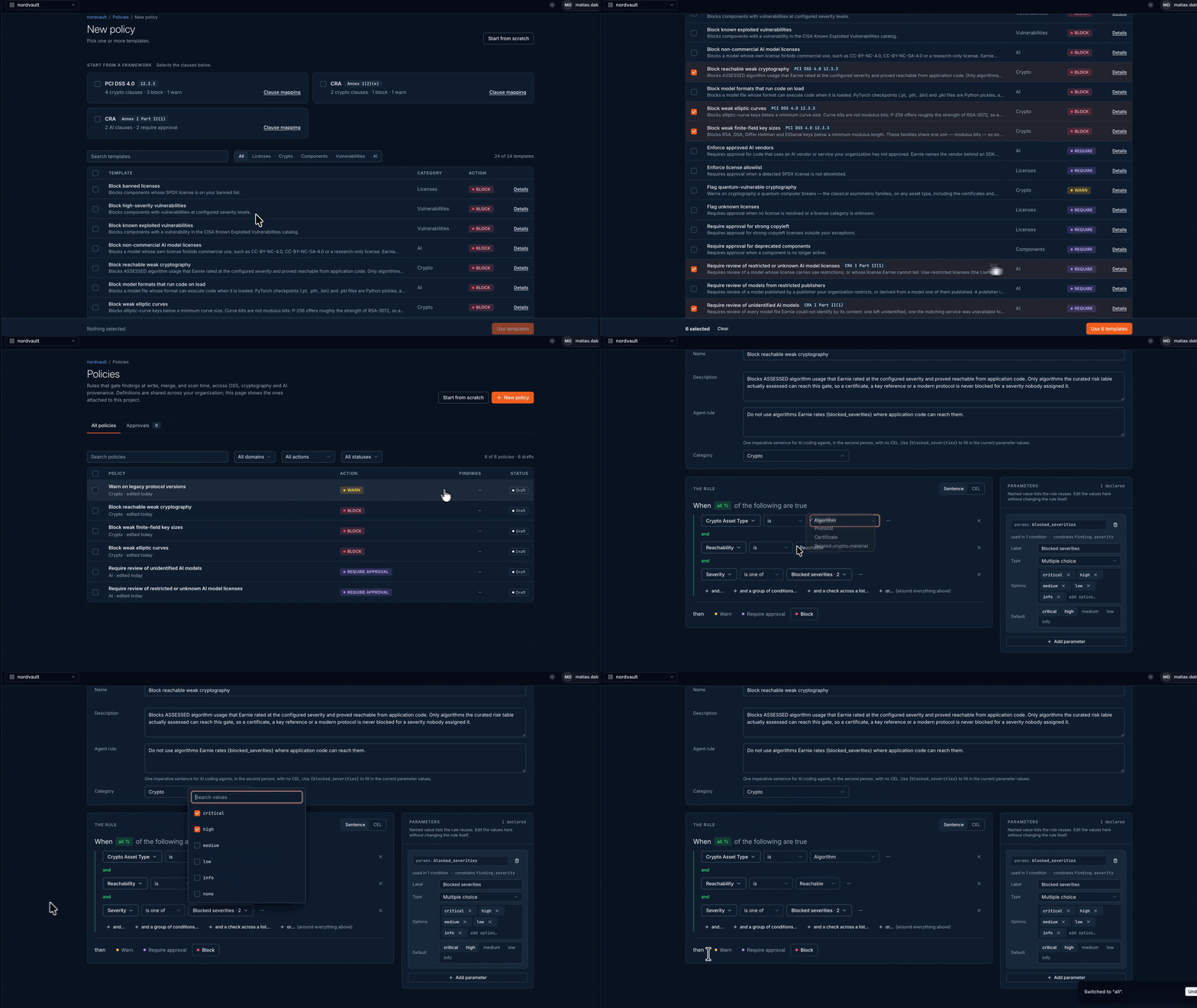
REC · UI
clip-policy-builder · Policy built in the UI · 0:15
Policy built in the UI: framework templates selected, policies created, then a rule edited

Your organisation thinks in projects. So does Earnie.

Assign repos, people and policies to a project. Different projects, different rules. Estate-level roll-up for the people who answer for all of them.
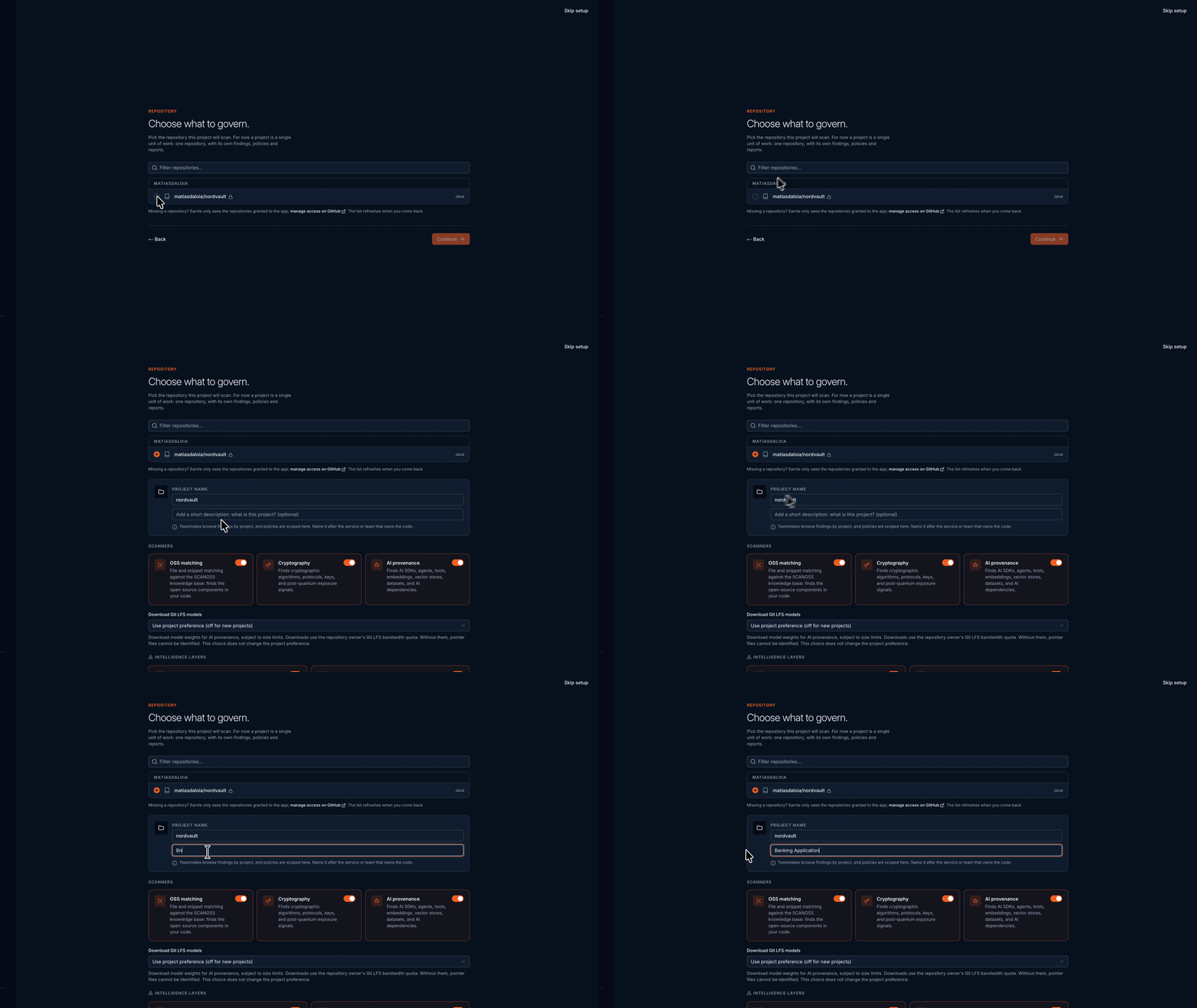
REC · UI
clip-project-setup · Repository picked, project created
Project set up in the UI: a repository picked, the project named and its scanners chosen

One policy, wherever code enters.

The coding agent · MCP

Asks Earnie what's allowed before it writes a line, and checks its own work after. On every task.

Works with: Claude Code · Cursor · OpenAI · any MCP client

The developer · CLI

One CLI for all of Earnie: scan, policy check, SBOM export. Run it pre-commit and findings show up before the code leaves your machine. Runs in any CI system we don't integrate with natively.

The developer · CI/CD

Connect a repository once. Earnie scans everything, then every commit and every pull request after it. Most rules warn, a few block.

Works with: GitHub · GitLab

The operator · UI

The AppSec or platform lead, in the browser. Policies, projects, posture and the whole estate.

EARNIE CLI
earnie scan ./payments-service
↳ Scanning 1,204 files…
↳ Found 38 open source components, 2 embedded AI models,
  14 cryptographic algorithms.
↳ 3 policy violations flagged. Evidence linked.

Same finding ID, same evidence, whichever surface caught it.

If you're not writing code, you can review and remediate from the UI, without opening a console.

Work from your browser.

Two ways in. Upload a package, a directory or a ZIP and see the results on your screen in minutes. No pipeline integration required. Or connect a repository once: Earnie runs the initial scan, then scans every commit after it. Policy violations become events, not archaeology.

Scans started here produce the same findings, with the same finding IDs and the same evidence, as scans triggered from MCP, CLI or CI/CD. One-shot scans still matter (due diligence has deadlines), but the record they write is the same record everything else writes to.

  • Upload & scan:
    Packages, directories, ZIP, results in minutes
  • Connect a repo:
    Initial scan, then continuous on every commit
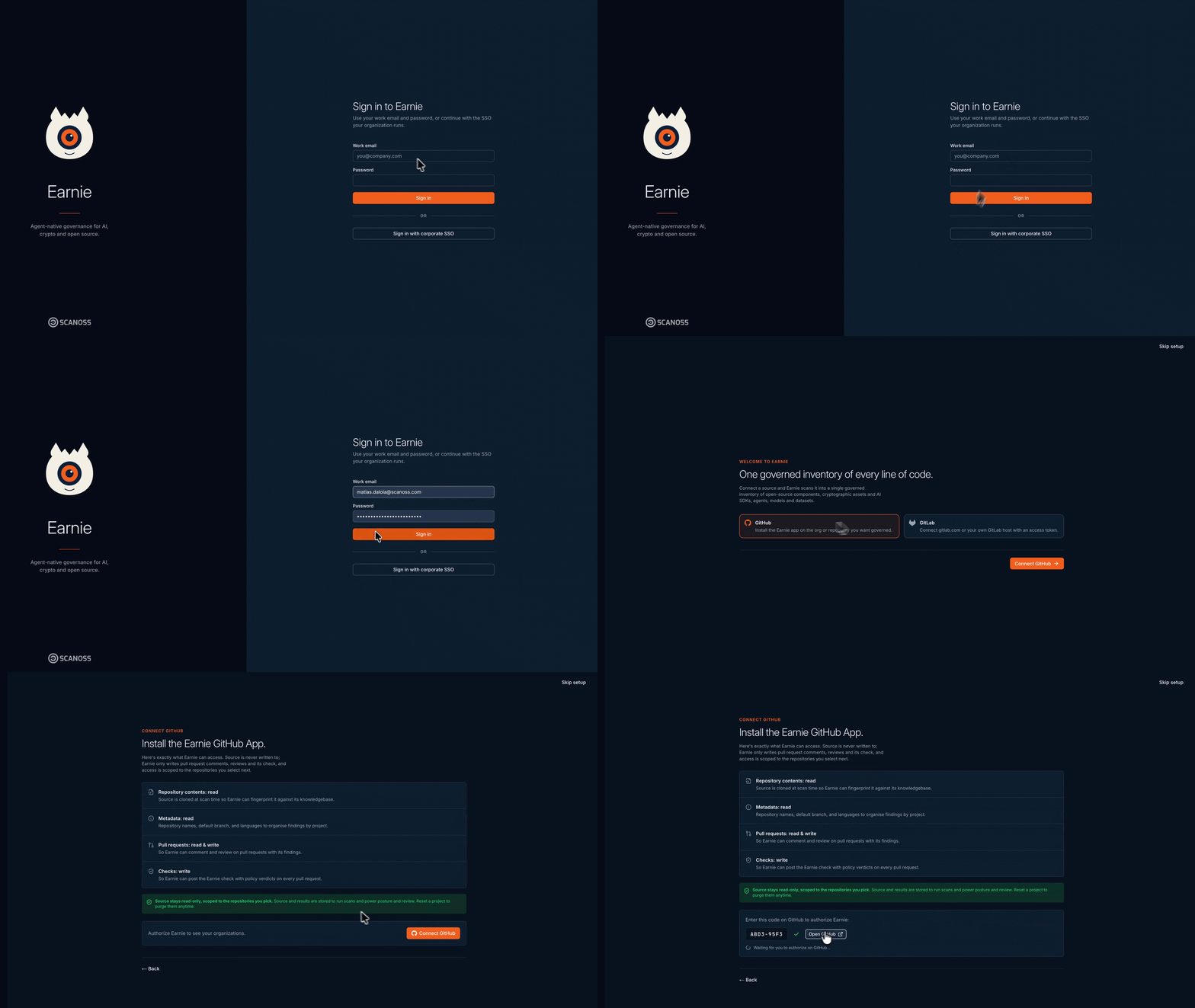
REC · UI
clip-live-scan · Sign in, then connect GitHub
Working from the browser: signing in to Earnie, then connecting a GitHub repository

The record writes itself.

As the team works on any surface, findings are recorded and the record is always up to date.

Split-screen view: See the match, not just the claim.

Any finding opens into a side-by-side comparison of your code against the identified source: match percentage, line by line, in the same UI where the finding lives. Findings you can defend because you can show them.
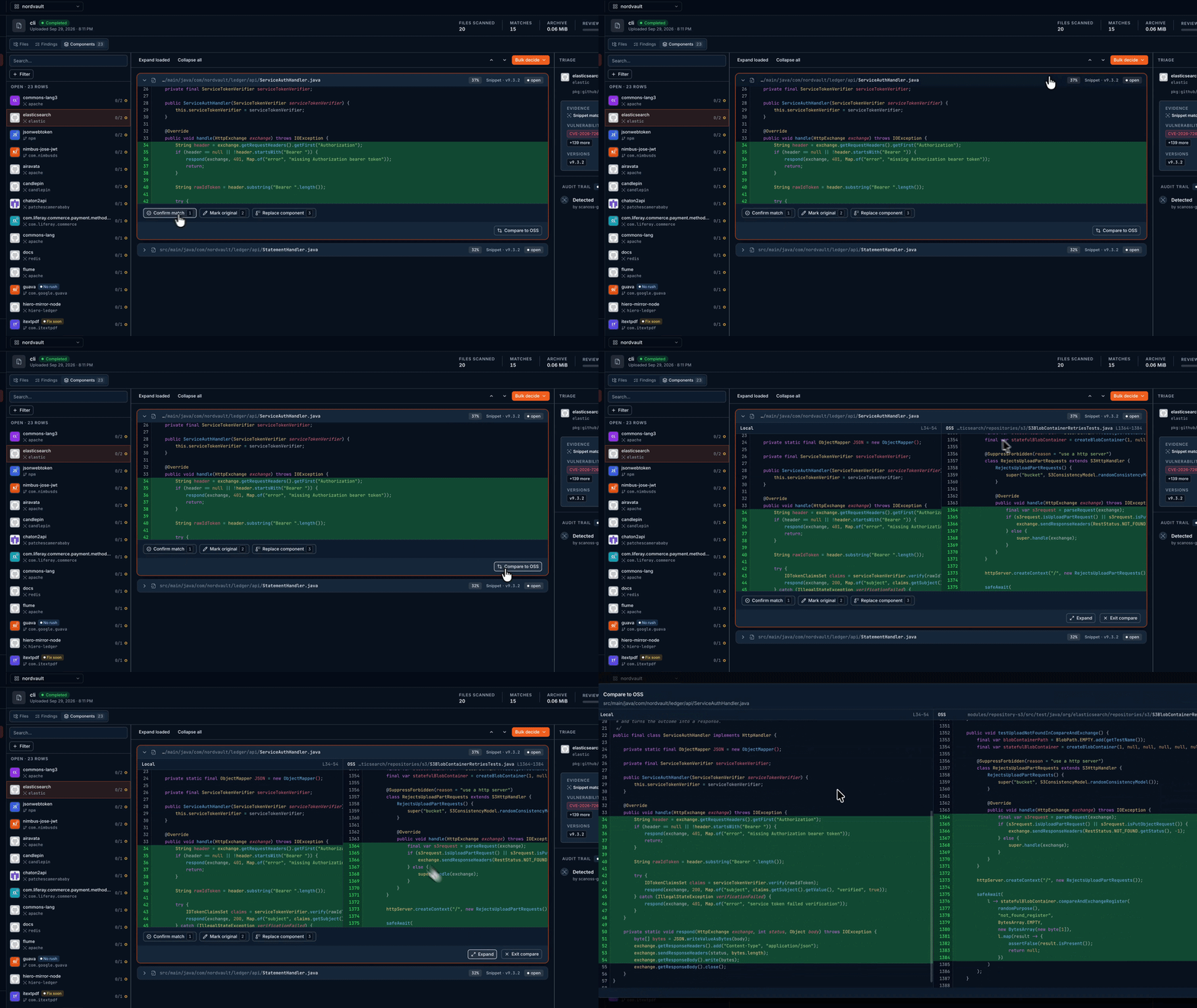
REC · UI
clip-match-comparison · Split-screen match against the open source
Split-screen view: a finding opened side by side with the matched open source file, matching lines highlighted

The dashboard: The whole estate at a glance.

Traffic-light status across every project. Developers see deltas; leadership sees posture. Single sign-on, role-gated: developers, engineering leadership, counsel and policy owners see the same truth at the depth their role requires.
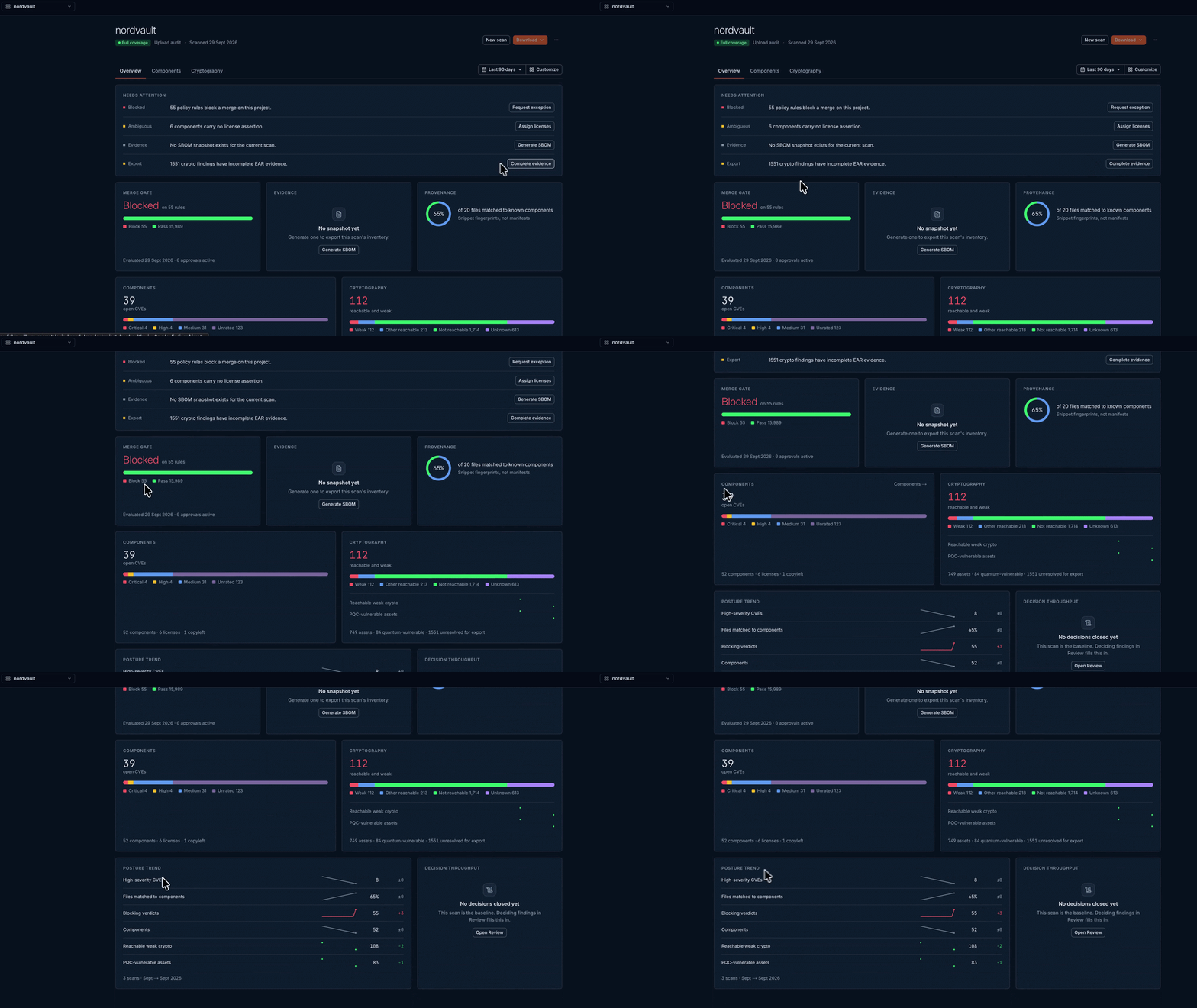
REC · UI
clip-estate-view · Project dashboard, traffic-light status
The dashboard: a project's merge gate, provenance, components, cryptography and posture trend at a glance

Get your BOM: Ready before anyone asks.

SBOM, CBOM and AIBOM, notice files, versioned, retrievable, and always current. Exported on demand in open standards: CycloneDX 1.6 and SPDX. Evidence towards CRA, procurement and EU AI Act obligations.
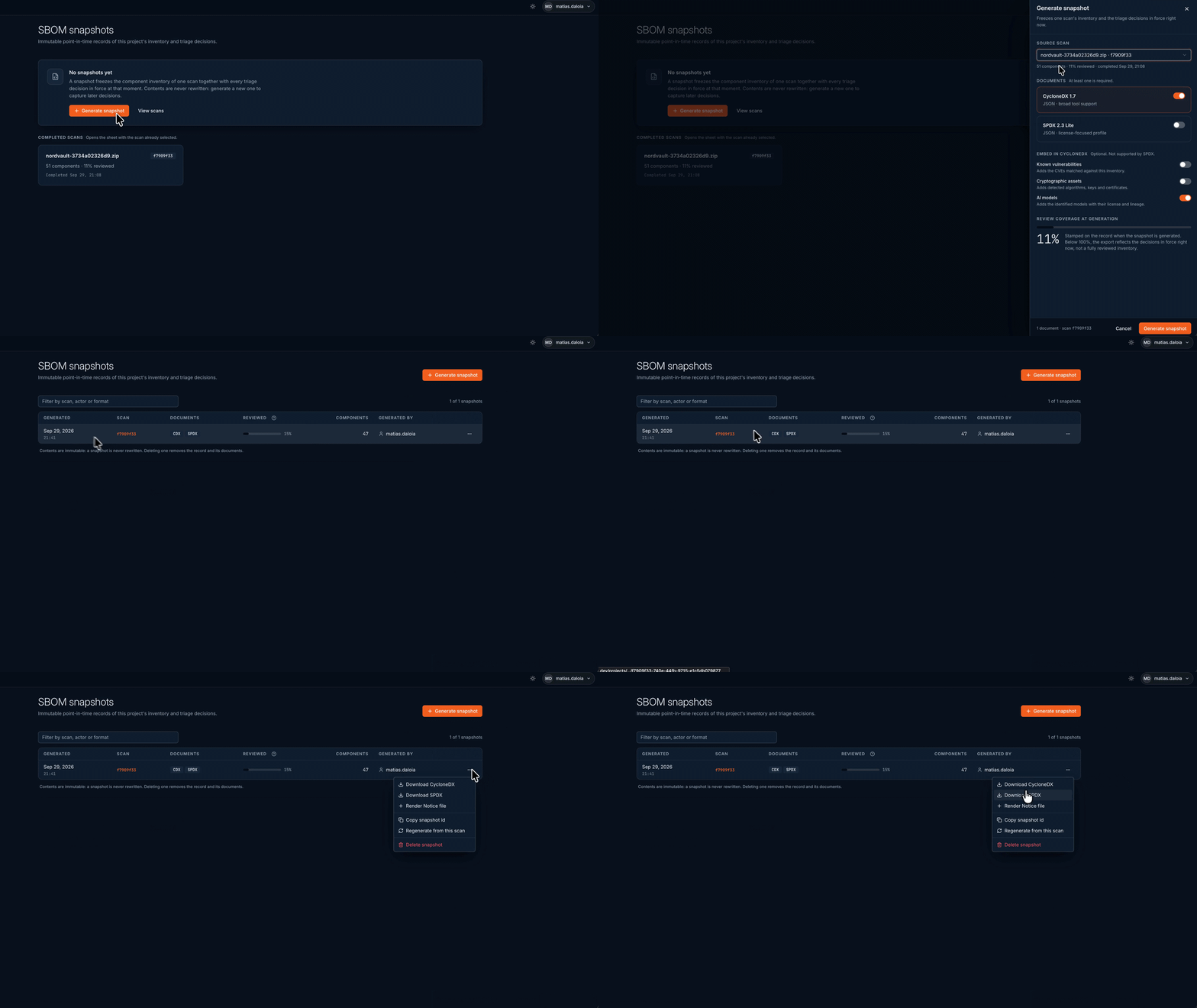
REC · UI
clip-sbom-download · SBOM snapshot generated in the UI
Get your BOM: an SBOM snapshot generated from a scan in CycloneDX and SPDX

Your server either way. Same record.

Earnie runs on your server in both models, with your code and your record. On SaaS it sends only fingerprints to the knowledge base we host. On-prem the knowledge base runs alongside it, air-gapped if you need it.

Hosted by us
Your network
Matches
Your code stays on your server
Earnie UI + API
ready
Crypto detectionlocal
OSS fingerprintingvia KB
AI model fingerprintingvia KB
Your recordupdated
findings · BOM · decisions
Knowledge base Earnie · hosted API
Returns
Component + version Licence CVEs Snippet origin AI model provenance
Fingerprints hashes only
Internet
Not required
KB updateoffline bundle · periodic
manual transfer
Deployment: SaaSSaaS. Your code, Earnie and your record stay in your network. Earnie sends only fingerprints to the knowledge base, hosted by us, and gets matches back.YOUR NETWORKYour codeEarnieUI + APIYour recordMatchesFingerprintsKnowledge baseEarnie · hosted APIHOSTEDBY US

How we handle your code →

One policy. Every surface. The whole record.

Request a demo
How Earnie works
Earnie

Four datasets. One policy manager. Every surface.

Earnie identifies what's really inside your code, no matter who (or what) wrote it. Then, whenever code enters, Earnie checks every snippet against your set policy, and records every decision.

How Earnie works: Data, Policy, Surfaces, Record Code from humans, open source and AI agents enters a single line through four steps. Data: What's really in the code, matched against the knowledge base. Policy: Your rules, set once per project, in clicks or code. Surfaces: Checked in the agent's session, at the keyboard, at merge and in the browser. Record: Every finding, decision and fix, versioned and on demand. The line ends at the record. Each step links to its section below. HumansOpen sourceAI agentsDataWhat's really in thecode, matched againstthe knowledge base.PolicyYour rules, set onceper project, in clicksor code.SurfacesChecked in the agent'ssession, at thekeyboard, at merge andin the browser.RecordEvery finding, decisionand fix, versioned andon demand. How Earnie works: Data, Policy, Surfaces, Record Code from humans, open source and AI agents enters a single line through four steps. Data: What's really in the code, matched against the knowledge base. Policy: Your rules, set once per project, in clicks or code. Surfaces: Checked in the agent's session, at the keyboard, at merge and in the browser. Record: Every finding, decision and fix, versioned and on demand. The line ends at the record. Each step links to its section below. HumansOpen sourceAI agentsDataWhat's really in the code, matchedagainst the knowledge base.PolicyYour rules, set once per project, inclicks or code.SurfacesChecked in the agent's session, atthe keyboard, at merge and in thebrowser.RecordEvery finding, decision and fix,versioned and on demand.

We don't read the label. We read the code.

Earnie is new, but the knowledge base is not. Policy, surfaces and record are built for code written by humans and agents alike. Underneath sits a proven knowledge base and an improved matching engine.

Meet the team behind Earnie →

188M+
Open source components
3T
Lines of code fingerprinted
120+
Cryptographic algorithms detected
150+
AI/ML packages recognised
12
Programming languages scanned
12
AI model file formats: Safetensors, GGUF, ONNX, PyTorch and more

Four datasets. Each one held to your policy.

AI models

Detection over declaration. AI SDKs, model files and API keys found, matched against known models and held to your policy. Documented in an AIBOM with provenance and licence. What's really there, in writing.

Cryptography & PQC

Every cryptographic algorithm in your estate, inventoried and checked against policy, with flags on what won't survive the post-quantum transition. The migration starts with an inventory. Earnie keeps it standing.

OSS licence compliance

Components, licences, obligations, down to the snippet someone pasted. Policy applied before it ships. Attribution and notice files generated, SBOMs versioned and retrievable. The record, ready before anyone asks.

Security vulnerabilities

Known vulnerabilities in what you actually ship, found where they live, tied to remediation at AI speed. The fix arrives with the finding, usually one click away.

Four datasets, one policy Four datasets, Open source components, AI models, Cryptography & PQC, Security vulnerabilities, all feed into one node: your policy, which decides what is allowed, what warns and what blocks. From it comes one record: SBOM, AIBOM, CBOM, Notice files, Evidence, linked to source. Open source componentsAI modelsCryptography & PQCSecurity vulnerabilitiesSBOMAIBOMCBOMNotice filesEvidence, linked to sourceYour policyAllowWarnBlock Four datasets, one policy Four datasets, Open source components, AI models, Cryptography & PQC, Security vulnerabilities, all feed into one node: your policy, which decides what is allowed, what warns and what blocks. From it comes one record: SBOM, AIBOM, CBOM, Notice files, Evidence, linked to source. Open source componentsAI modelsCryptography & PQCSecurity vulnerabilitiesSBOMAIBOMCBOMNotice filesEvidence, linked to sourceYour policyAllowWarnBlock

Your rules. Written once. Checked everywhere.

Findings on their own are a to-do list. Policy decides what happens to them: what's allowed, what warns, what blocks.

Request a demo

Policies in clicks or code.

Central policies across licence, crypto, AI and security, expressed in CEL and compatible with the policy systems you already run. Build them point-and-click, the way you'd build an advanced search, or manage them through the API and MCP. Natural language is coming next.

REC · UI
clip-policy-builder · Policy built in the UI · 0:15
Policy built in the UI: framework templates selected, policies created, then a rule edited

Your organisation thinks in projects. So does Earnie.

Assign repos, people and policies to a project. Different projects, different rules. Estate-level roll-up for the people who answer for all of them.

REC · UI
clip-project-setup · Repository picked, project created
Project set up in the UI: a repository picked, the project named and its scanners chosen

One policy, wherever code enters.

The coding agent · MCP

Asks Earnie what's allowed before it writes a line, and checks its own work after. On every task.

Works with: Claude Code · Cursor · OpenAI · any MCP client

The developer · CLI

One CLI for all of Earnie: scan, policy check, SBOM export. Run it pre-commit and findings show up before the code leaves your machine. Runs in any CI system we don't integrate with natively.

The developer · CI/CD

Connect a repository once. Earnie scans everything, then every commit and every pull request after it. Most rules warn, a few block.

Works with: GitHub · GitLab

The operator · UI

The AppSec or platform lead, in the browser. Policies, projects, posture and the whole estate.

EARNIE CLI
earnie scan ./payments-service
↳ Scanning 1,204 files…
↳ Found 38 open source components, 2 embedded AI models,
  14 cryptographic algorithms.
↳ 3 policy violations flagged. Evidence linked.

Same finding ID, same evidence, whichever surface caught it.

If you're not writing code, you can review and remediate from the UI, without opening a console.

Work from your browser.

Two ways in. Upload a package, a directory or a ZIP and see the results on your screen in minutes. No pipeline integration required. Or connect a repository once: Earnie runs the initial scan, then scans every commit after it. Policy violations become events, not archaeology.

Scans started here produce the same findings, with the same finding IDs and the same evidence, as scans triggered from MCP, CLI or CI/CD. One-shot scans still matter (due diligence has deadlines), but the record they write is the same record everything else writes to.

  • Upload & scan:
    Packages, directories, ZIP, results in minutes
  • Connect a repo:
    Initial scan, then continuous on every commit
REC · UI
clip-live-scan · Sign in, then connect GitHub
Working from the browser: signing in to Earnie, then connecting a GitHub repository

The record writes itself.

As the team works on any surface, findings are recorded and the record is always up to date.

Split-screen view: See the match, not just the claim.

Any finding opens into a side-by-side comparison of your code against the identified source: match percentage, line by line, in the same UI where the finding lives. Findings you can defend because you can show them.

REC · UI
clip-match-comparison · Split-screen match against the open source
Split-screen view: a finding opened side by side with the matched open source file, matching lines highlighted

The dashboard: The whole estate at a glance.

Traffic-light status across every project. Developers see deltas; leadership sees posture. Single sign-on, role-gated: developers, engineering leadership, counsel and policy owners see the same truth at the depth their role requires.

REC · UI
clip-estate-view · Project dashboard, traffic-light status
The dashboard: a project's merge gate, provenance, components, cryptography and posture trend at a glance

Get your BOM: Ready before anyone asks.

SBOM, CBOM and AIBOM, notice files, versioned, retrievable, and always current. Exported on demand in open standards: CycloneDX 1.6 and SPDX. Evidence towards CRA, procurement and EU AI Act obligations.

REC · UI
clip-sbom-download · SBOM snapshot generated in the UI
Get your BOM: an SBOM snapshot generated from a scan in CycloneDX and SPDX

Your server either way. Same record.

Earnie runs on your server in both models, with your code and your record. On SaaS it sends only fingerprints to the knowledge base we host. On-prem the knowledge base runs alongside it, air-gapped if you need it.

Hosted by us
Your network
Matches
{{ packets }}
Your code stays on your server
Earnie UI + API
{{ status }}
Crypto detectionlocal
OSS fingerprintingvia KB
AI model fingerprintingvia KB
Your recordupdated
findings · BOM · decisions
Knowledge base Earnie · hosted API Earnie · offline, on your server
Returns
Component + version Licence CVEs Snippet origin AI model provenance
Fingerprints hashes only
Internet
Not required
KB updateoffline bundle · periodic
manual transfer
{{ popTitle }} {{ popMeta }}

{{ popBody }}

12=5f1c9a0e,b72e04d1 17=93d2e10f 19=c05e9a13,6e3d21b8
Deployment: SaaSSaaS. Your code, Earnie and your record stay in your network. Earnie sends only fingerprints to the knowledge base, hosted by us, and gets matches back.YOUR NETWORKYour codeEarnieUI + APIYour recordMatchesFingerprintsKnowledge baseEarnie · hosted APIHOSTEDBY USDeployment: on-prem or air-gappedOn-prem. Your code, Earnie, your record and the knowledge base all run on your server. Earnie sends fingerprints to the knowledge base and gets matches back inside your network. No internet connection is required.YOUR NETWORKYour codeEarnieUI + APIYour recordMatchesFingerprintsKnowledge baseOffline, on your serverNot requiredInternet

How we handle your code →

One policy. Every surface. The whole record.

Request a demo