
Earnie
ARTICLEAI PROVENANCE

Stop building catalogues of AI models you can't identify

An AI model catalogue only scales when every entry carries evidence of where the model came from.
Giuliana Bruni
Marketing Content Specialist
7 min read
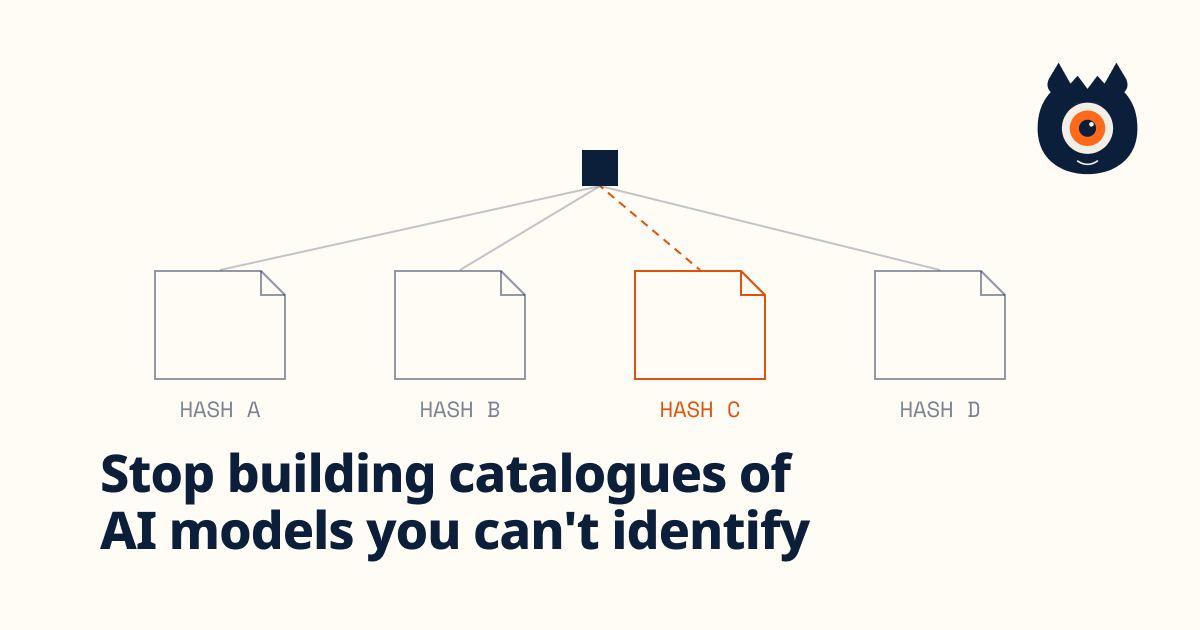
One base AI model branching into four variant files with different hashes, linked by lineage

TL;DR: AI models change form as teams quantise, fine-tune and convert them, and catalogues built by manual investigation can't keep pace. This article explains why governing AI models depends on reusable provenance evidence, and how Earnie links each model file to its lineage, its licence and your policies.

Governing AI models has become a scaling problem

Governing AI models has become a scaling problem, because one model rarely arrives in one form. A developer downloads an open-weight model. A colleague picks up a quantised version of it, and someone else fine-tunes it or converts it to another file format. By the end of the week the file names, hashes, repositories and metadata all differ, and the foundation underneath is still the same.

Each new form brings the old questions back. Where did this model come from, and which licence applies to it? Which known models is it related to, and does an earlier assessment of the foundation still hold after the change?

Answering them once is manageable. Answering them for every derivative, at the speed developers and coding agents add them, is where catalogues fall behind.

Manual provenance investigations repeat the same work

Model provenance is the record of where a model came from: its base models, its publisher, its licence and how it was changed. Many organisations still rebuild that record by hand. An analyst reads repositories and model cards, searches for the original release, checks the licence and pieces the relationships together.

Then the next derivative arrives, and the same foundation gets investigated again. Metadata is often incomplete, repositories change or disappear, and separate teams keep separate inventories that never meet.

What an organisation needs is provenance evidence it can reuse across teams. Each team still needs room for its own approval rules. A model used for internal experiments carries different stakes from one in a production system that handles sensitive data.

Package scanning can't trace a transformed model

Software composition analysis (SCA) identifies third-party software through package metadata and exact file matching, and it remains essential for software dependencies, licences and known vulnerabilities. Transformed AI models are a harder case. Quantisation, fine-tuning, format conversion and sharding all change a file's hash and structure while keeping its relationship to the source model.

Consider a repository that calls an AI SDK and keeps a set of model weights next to it. A conventional scanner will find the SDK in the manifest. About where the weights came from, it has nothing to say.

Repository names and model cards can't always fill that gap, because whoever published the derivative wrote them. Governing AI models needs evidence about how models relate to each other as well as about individual files, and investigating component by component won't scale as the variants multiply.

Earnie matches each model file against known models

Earnie reads model files as model weights instead of skipping them as binaries. It covers formats including .safetensors, .gguf, .onnx and pickle-based files such as .pt and .bin, and it also finds AI usage in code, such as AI SDKs and embedding models. Each model file is fingerprinted and matched against the AI provenance knowledge base.

A finding shows the candidate model and how the match was made, anywhere from an exact file hash down to a file name only. It also carries a confidence band of high, medium or low. When the match can't fully separate the file from similar known models, the finding lists those related candidates, and a file Earnie can't identify still becomes a finding and goes to review.

The analyst starts from evidence, with no need to reconstruct an unfamiliar file's history from scratch. Not every match is definitive, and coverage depends on the reference data. The value lies in narrowing the search and connecting what's found to policy.

Lineage connects a derivative to its base model

Lineage is the set of base models a model was derived from. For each identified model, Earnie records its lineage, its licence, its declared datasets and its model card, together with how it was transformed: fine-tuned, quantised, merged, distilled or used as an adapter. Each identified model also gets a licence category, ranging from permissive and copyleft through use-restricted and non-commercial to proprietary or unknown.

Lineage matters because obligations travel with a model. A non-commercial licence on a base model can follow a fine-tune into a commercial product without anyone ever choosing it.

The catalogue entry worth having is the one that ties a file to its history. Our research fingerprinting 25,000 AI models showed how hard it can be to recognise the same foundation after quantisation, format conversion, sharding or architectural changes.

Identifying a model leaves the approval decision to policy

Knowing what a model is doesn't settle whether you can ship it. A policy in Earnie makes that call, deciding whether a finding is blocked, raises a warning or requires approval. The decision depends on the model's licence, how it was modified, the security evidence and what the application lets the model do.

An organisation that has approved a foundation model can still treat its derivatives differently. Policies can read a model's licence category, transform kind, confidence band and the publishers in its lineage. Earnie's built-in template for derived models warns on fine-tuned, merged, distilled and adapter models, and an organisation can write a stricter rule that requires approval for every fine-tune. Other templates block non-commercial licences and model formats that run code on load, and require review of unidentified models.
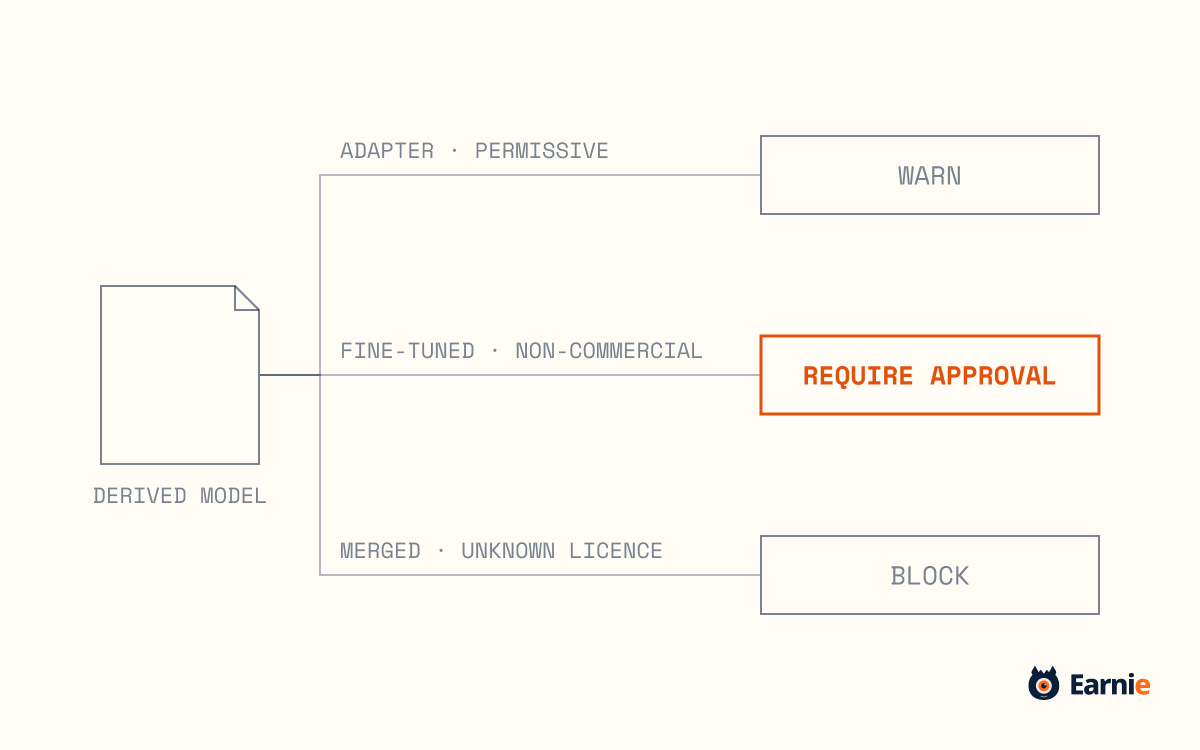
A derived model routed to warn, require approval or block, by transform kind and licence category

Approvals stay tied to evidence. A policy approval in Earnie covers one finding against one policy in one project, and it carries forward to later scans until it expires or is revoked. A related model doesn't inherit it, so each new derivative gets its own recorded decision, made on shared evidence.

The same model can need different controls in different products

Use case shapes the approval decision as much as provenance does. A model may be acceptable for summarising public documents and need stronger controls once it's connected to internal systems or to tools that run commands. Regulated industries may also need extra documentation and privacy safeguards before a model reaches production.

That is why the two jobs stay separate. Provenance evidence describes what a model file is and how it relates to other models, and the organisation's policies decide what that means for approval in each project. The same evidence can support different decisions, project by project, without assuming one risk tolerance for everyone.

Timing matters too. The same policies run at pre-commit and at merge, so the decision applies when the model arrives. Your code stays on your server. On SaaS, only fingerprints leave it.

Model provenance changes every week

Model provenance data starts ageing the day it's recorded. Our research monitors a subset of Hugging Face models that can run on commercially available hardware, and within that population alone roughly 1,000 to 1,500 model variants appear or disappear every week. Around 70% of the monitored entries lack adequate information about their parent models or licensing.

New derivatives, redistributed models, deleted repositories and newly published documentation keep changing the evidence after an entry is written. A static catalogue can only record what was known at one moment.

Provenance needs a reference that is maintained continuously. The AI provenance knowledge base gives teams an evolving record to check files against, and every scan with AI provenance enabled checks the repository against it again.

Documentation duties for AI systems are growing

The AI Act is the EU regulation on artificial intelligence. According to the European Commission, the AI Act became applicable on 2 August 2026, with exceptions that extend some high-risk obligations to December 2027 and August 2028. Precise duties depend on the organisation's role and on how each system is classified.

Whatever the classification, documentation and traceability for AI components are becoming things buyers and auditors check. Earnie exports each identified model as a CycloneDX machine-learning-model component with its licence and lineage, as part of an AIBOM (AI bill of materials).

Automated discovery and policy decisions don't replace legal review or security testing. They make the supporting evidence easier to collect and keep current, so a team that already holds provenance evidence for every model file can answer those checks from its records instead of opening a fresh investigation.

Governing AI models at scale starts with reusable evidence

Model fingerprinting solves the identification problem, and organisations need more than identification. They need discovery, the relationships between models, licence investigation and their own policies applied consistently. Some decisions can run automatically through policy and others need a person, and both depend on reliable evidence.

For a business decision-maker, one question is worth asking. How much of your team's time goes into investigating the same model foundations again and again? Earnie keeps provenance evidence attached to every model file and applies your policies on every change, so that time goes into decisions. See it on your kind of codebase: request a demo.

RELATED READING

See it on your kind of codebase.

Request a demo
Stop building catalogues of AI models you can't identify
Earnie
ARTICLEAI PROVENANCE

Stop building catalogues of AI models you can't identify

An AI model catalogue only scales when every entry carries evidence of where the model came from.

Giuliana Bruni
Marketing Content Specialist
7 min read
One base AI model branching into four variant files with different hashes, linked by lineage

TL;DR: AI models change form as teams quantise, fine-tune and convert them, and catalogues built by manual investigation can't keep pace. This article explains why governing AI models depends on reusable provenance evidence, and how Earnie links each model file to its lineage, its licence and your policies.

Governing AI models has become a scaling problem

Governing AI models has become a scaling problem, because one model rarely arrives in one form. A developer downloads an open-weight model. A colleague picks up a quantised version of it, and someone else fine-tunes it or converts it to another file format. By the end of the week the file names, hashes, repositories and metadata all differ, and the foundation underneath is still the same.

Each new form brings the old questions back. Where did this model come from, and which licence applies to it? Which known models is it related to, and does an earlier assessment of the foundation still hold after the change?

Answering them once is manageable. Answering them for every derivative, at the speed developers and coding agents add them, is where catalogues fall behind.

Manual provenance investigations repeat the same work

Model provenance is the record of where a model came from: its base models, its publisher, its licence and how it was changed. Many organisations still rebuild that record by hand. An analyst reads repositories and model cards, searches for the original release, checks the licence and pieces the relationships together.

Then the next derivative arrives, and the same foundation gets investigated again. Metadata is often incomplete, repositories change or disappear, and separate teams keep separate inventories that never meet.

What an organisation needs is provenance evidence it can reuse across teams. Each team still needs room for its own approval rules. A model used for internal experiments carries different stakes from one in a production system that handles sensitive data.

Package scanning can't trace a transformed model

Software composition analysis (SCA) identifies third-party software through package metadata and exact file matching, and it remains essential for software dependencies, licences and known vulnerabilities. Transformed AI models are a harder case. Quantisation, fine-tuning, format conversion and sharding all change a file's hash and structure while keeping its relationship to the source model.

Consider a repository that calls an AI SDK and keeps a set of model weights next to it. A conventional scanner will find the SDK in the manifest. About where the weights came from, it has nothing to say.

Repository names and model cards can't always fill that gap, because whoever published the derivative wrote them. Governing AI models needs evidence about how models relate to each other as well as about individual files, and investigating component by component won't scale as the variants multiply.

Earnie matches each model file against known models

Earnie reads model files as model weights instead of skipping them as binaries. It covers formats including .safetensors, .gguf, .onnx and pickle-based files such as .pt and .bin, and it also finds AI usage in code, such as AI SDKs and embedding models. Each model file is fingerprinted and matched against the AI provenance knowledge base.

A finding shows the candidate model and how the match was made, anywhere from an exact file hash down to a file name only. It also carries a confidence band of high, medium or low. When the match can't fully separate the file from similar known models, the finding lists those related candidates, and a file Earnie can't identify still becomes a finding and goes to review.

The analyst starts from evidence, with no need to reconstruct an unfamiliar file's history from scratch. Not every match is definitive, and coverage depends on the reference data. The value lies in narrowing the search and connecting what's found to policy.

Lineage connects a derivative to its base model

Lineage is the set of base models a model was derived from. For each identified model, Earnie records its lineage, its licence, its declared datasets and its model card, together with how it was transformed: fine-tuned, quantised, merged, distilled or used as an adapter. Each identified model also gets a licence category, ranging from permissive and copyleft through use-restricted and non-commercial to proprietary or unknown.

Lineage matters because obligations travel with a model. A non-commercial licence on a base model can follow a fine-tune into a commercial product without anyone ever choosing it.

The catalogue entry worth having is the one that ties a file to its history. Our research fingerprinting 25,000 AI models showed how hard it can be to recognise the same foundation after quantisation, format conversion, sharding or architectural changes.

Identifying a model leaves the approval decision to policy

Knowing what a model is doesn't settle whether you can ship it. A policy in Earnie makes that call, deciding whether a finding is blocked, raises a warning or requires approval. The decision depends on the model's licence, how it was modified, the security evidence and what the application lets the model do.

An organisation that has approved a foundation model can still treat its derivatives differently. Policies can read a model's licence category, transform kind, confidence band and the publishers in its lineage. Earnie's built-in template for derived models warns on fine-tuned, merged, distilled and adapter models, and an organisation can write a stricter rule that requires approval for every fine-tune. Other templates block non-commercial licences and model formats that run code on load, and require review of unidentified models.

A derived model routed to warn, require approval or block, by transform kind and licence category

Approvals stay tied to evidence. A policy approval in Earnie covers one finding against one policy in one project, and it carries forward to later scans until it expires or is revoked. A related model doesn't inherit it, so each new derivative gets its own recorded decision, made on shared evidence.

The same model can need different controls in different products

Use case shapes the approval decision as much as provenance does. A model may be acceptable for summarising public documents and need stronger controls once it's connected to internal systems or to tools that run commands. Regulated industries may also need extra documentation and privacy safeguards before a model reaches production.

That is why the two jobs stay separate. Provenance evidence describes what a model file is and how it relates to other models, and the organisation's policies decide what that means for approval in each project. The same evidence can support different decisions, project by project, without assuming one risk tolerance for everyone.

Timing matters too. The same policies run at pre-commit and at merge, so the decision applies when the model arrives. Your code stays on your server. On SaaS, only fingerprints leave it.

Model provenance changes every week

Model provenance data starts ageing the day it's recorded. Our research monitors a subset of Hugging Face models that can run on commercially available hardware, and within that population alone roughly 1,000 to 1,500 model variants appear or disappear every week. Around 70% of the monitored entries lack adequate information about their parent models or licensing.

New derivatives, redistributed models, deleted repositories and newly published documentation keep changing the evidence after an entry is written. A static catalogue can only record what was known at one moment.

Provenance needs a reference that is maintained continuously. The AI provenance knowledge base gives teams an evolving record to check files against, and every scan with AI provenance enabled checks the repository against it again.

Documentation duties for AI systems are growing

The AI Act is the EU regulation on artificial intelligence. According to the European Commission, the AI Act became applicable on 2 August 2026, with exceptions that extend some high-risk obligations to December 2027 and August 2028. Precise duties depend on the organisation's role and on how each system is classified.

Whatever the classification, documentation and traceability for AI components are becoming things buyers and auditors check. Earnie exports each identified model as a CycloneDX machine-learning-model component with its licence and lineage, as part of an AIBOM (AI bill of materials).

Automated discovery and policy decisions don't replace legal review or security testing. They make the supporting evidence easier to collect and keep current, so a team that already holds provenance evidence for every model file can answer those checks from its records instead of opening a fresh investigation.

Governing AI models at scale starts with reusable evidence

Model fingerprinting solves the identification problem, and organisations need more than identification. They need discovery, the relationships between models, licence investigation and their own policies applied consistently. Some decisions can run automatically through policy and others need a person, and both depend on reliable evidence.

For a business decision-maker, one question is worth asking. How much of your team's time goes into investigating the same model foundations again and again? Earnie keeps provenance evidence attached to every model file and applies your policies on every change, so that time goes into decisions. See it on your kind of codebase: request a demo.

RELATED READING
ARTICLE · PQC / CRYPTO READINESS
Germany's PQC plan starts with a cryptographic inventory

See it on your kind of codebase.

Request a demo