
PQC migration starts with knowing what’s in your code.
Earnie discovers cryptographic assets in source code and dependencies, assesses their post-quantum status, and helps organisations apply consistent policies and track changes across development workflows.
Request a demoThe post-quantum timeline is already set
FIPS 203, 204 and 205 published
ML-KEM for key establishment, ML-DSA and SLH-DSA for signatures.
NIST IR 8547 finalised
The schedule for retiring quantum-vulnerable algorithms.
Deprecated
Every quantum-vulnerable signature and key-establishment algorithm, at any key size. Federal high-value systems switch key establishment by now.
Federal signatures
Federal high-value and high-impact systems move digital signatures to post-quantum, under Executive Order 14412.
Disallowed
Quantum-vulnerable algorithms leave NIST standards. National Security Memorandum 10’s target for federal migration.
Sources: NIST IR 8547, Transition to Post-Quantum Cryptography Standards (final, 27 October 2026) and NIST’s announcement of it, which sets out the Executive Order 14412 and National Security Memorandum 10 dates.
From cryptographic discovery to migration governance
A migration programme needs an accurate view of cryptographic usage, a way to prioritise work and controls on new development. Earnie supports it in five connected steps.
Discover cryptographic assets
Earnie finds algorithms, protocols and certificates in source code and dependencies. Findings can include the file and line where an asset occurs.
Illustrative example
Assess post-quantum exposure
Assessed findings get a post-quantum status. Hashes, symmetric ciphers, MACs and key-derivation functions are Not applicable, and Unassessed is never treated as Safe.
Vulnerable
Safe
Not applicable
Unassessed
Illustrative classification of common algorithms
Prioritise with reachability
Each finding is Reachable, Unreachable or Unknown. Reachable findings move up one severity level, and Unknown stays distinct from Unreachable.
Illustrative example
Govern development workflows
Seven cryptography policy templates run in developer self-checks and pull request scans, with three actions.
GitHub can enforce the result as a required status check. GitLab is currently advisory.
Track changes and export CBOM
The Crypto changes view shows findings between scans. CBOM snapshots in CycloneDX record the inventory at a point in time.
What it looks like in Earnie
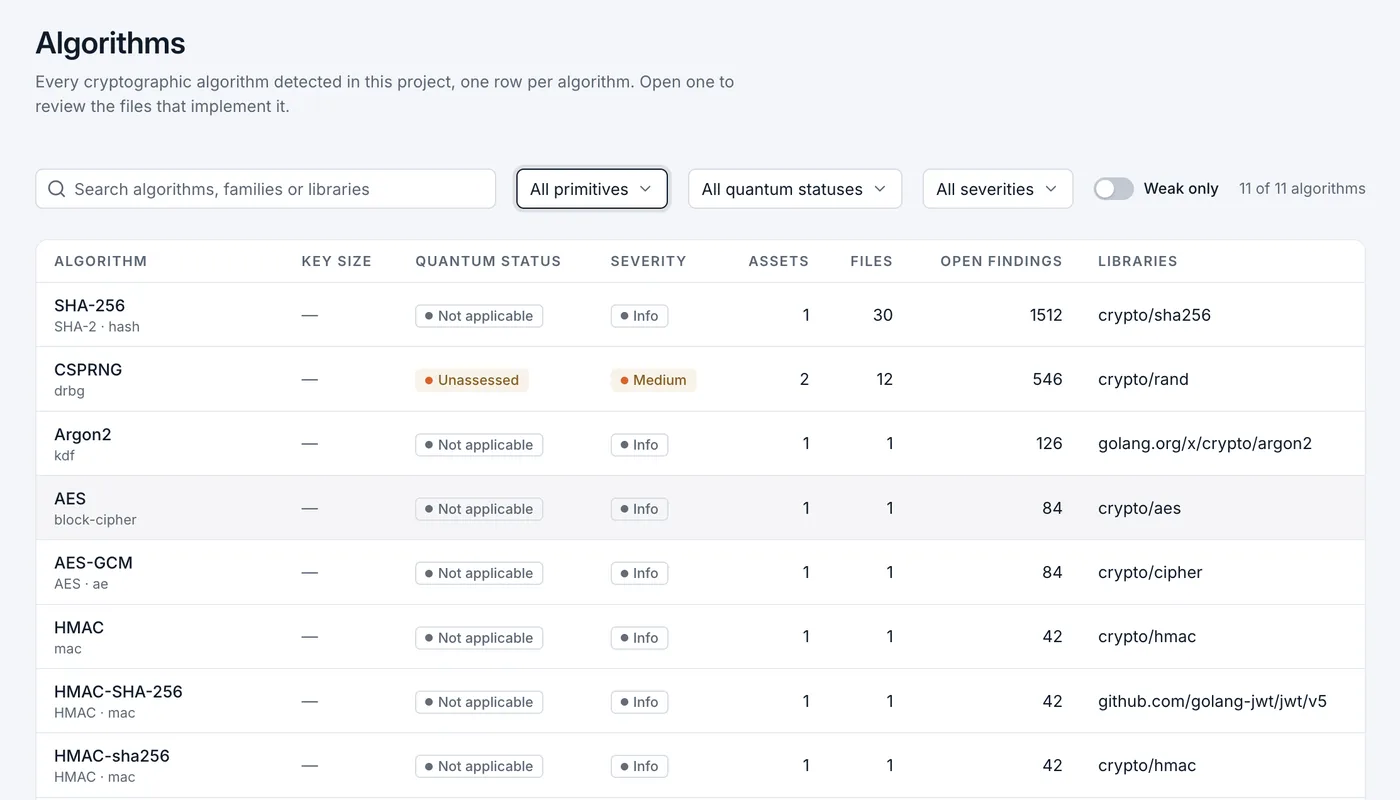
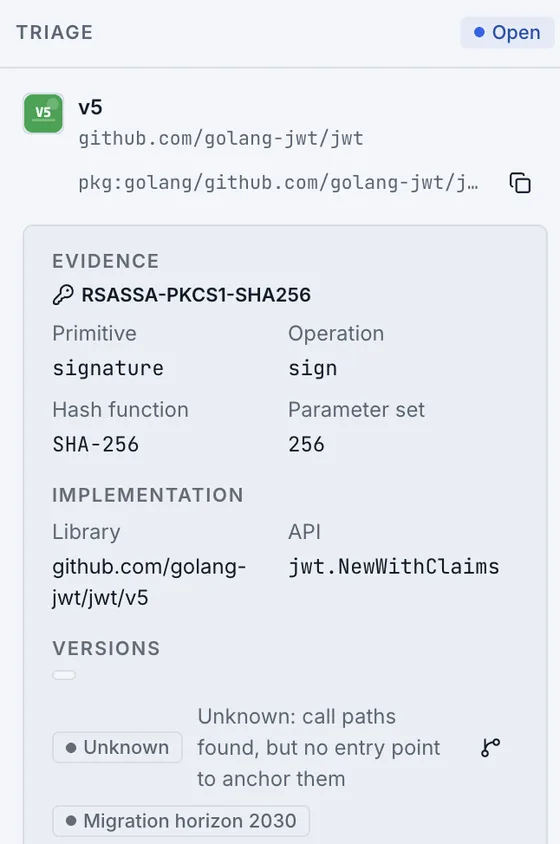
Anonymised extract from a real Earnie CBOM (CycloneDX 1.7) for an example project: the document header and one algorithm component, with its evidence shortened to two occurrences. CBOM export requires a cryptography scan with the necessary evidence, snapshots are immutable, and fields vary with the evidence available.
A governance layer for your post-quantum migration programme
Discover
Identify cryptographic assets across source code and dependencies.
Assess
Review PQC status, reachability, severity and supporting evidence.
Govern
Define cryptographic policies and apply them across supported development workflows.
Track
Monitor changes, review findings and export CBOM snapshots.
Replacing cryptographic algorithms involves engineering decisions, compatibility testing, dependency updates and deployment planning. Those activities remain with your engineering teams and migration partners. Earnie supports the programme around that work by providing cryptographic visibility, assessment, governance and tracking.
Questions about PQC migration and Earnie
What is post-quantum cryptography migration?
It is the programme of moving from public-key algorithms that a sufficiently powerful quantum computer could break, such as RSA and elliptic-curve cryptography, to post-quantum algorithms such as those NIST standardised in 2024. It involves building an inventory, prioritising work, making engineering changes, testing compatibility and deploying the results.
Why does an organisation need a cryptographic inventory before PQC migration?
Teams can only plan changes to cryptography they know about. Cryptography is used in an organisation’s own code and in its dependencies, so an inventory built from the code gives the programme a starting point for scoping, prioritisation and planning.
What does Earnie detect?
Earnie’s cryptography scanning identifies cryptographic algorithms, protocols and certificates in source code and dependencies. Findings can include evidence of where an asset occurs, such as the source file and line number.
Which programming languages does Earnie support for cryptographic detection?
Java, Go, JavaScript, Python, Rust, C, C++, C# and Ruby.
How does Earnie identify quantum-vulnerable algorithms?
Earnie assigns a post-quantum status to assessed cryptographic findings: Vulnerable, Safe, Not applicable or Unassessed. Not applicable covers hashes, symmetric ciphers, MACs and key-derivation functions, which sit outside the scope of PQC vulnerability assessment. Unassessed means Earnie has not established a PQC status for the algorithm, and it should not be read as Safe.
What is a CBOM?
A Cryptographic Bill of Materials is a structured inventory of the cryptographic assets in a piece of software. Earnie exports CBOMs in CycloneDX format. Depending on the available scan evidence, an export can include algorithms, keys, certificates, protocols, source evidence, reachability, PQC status and export-control context.
CBOM export requires a cryptography scan with the necessary evidence, and each CBOM snapshot is immutable.
Can Earnie automatically replace vulnerable cryptographic algorithms?
No. Replacing algorithms involves engineering decisions, compatibility testing, dependency updates and deployment planning, which remain with your engineering teams and migration partners. Earnie supports that work with discovery, assessment, policy governance and tracking.
Can Earnie enforce cryptographic policies in pull requests?
Pull request scans provide the merge-gate verdict for a proposed change, using policies set to block, require approval or warn. GitHub can enforce Earnie’s result when the relevant status check is configured as required. GitLab is currently advisory.
Does a developer self-check provide a complete cryptographic scan?
No. Self-checks give developers and coding agents an early policy check on changed files. They examine a subset of those files, so they are a partial check rather than a full project scan. Pull request scans provide the merge-gate verdict.
Start your PQC migration with a clear view of your cryptographic estate.
Discover where cryptography is used, understand which findings need attention and establish the policies to govern change across your software.
Request a demo