
Where compliance checks belong when agents write the code
Coding agents write code faster than review can follow, so the checks have to move closer to the prompt.
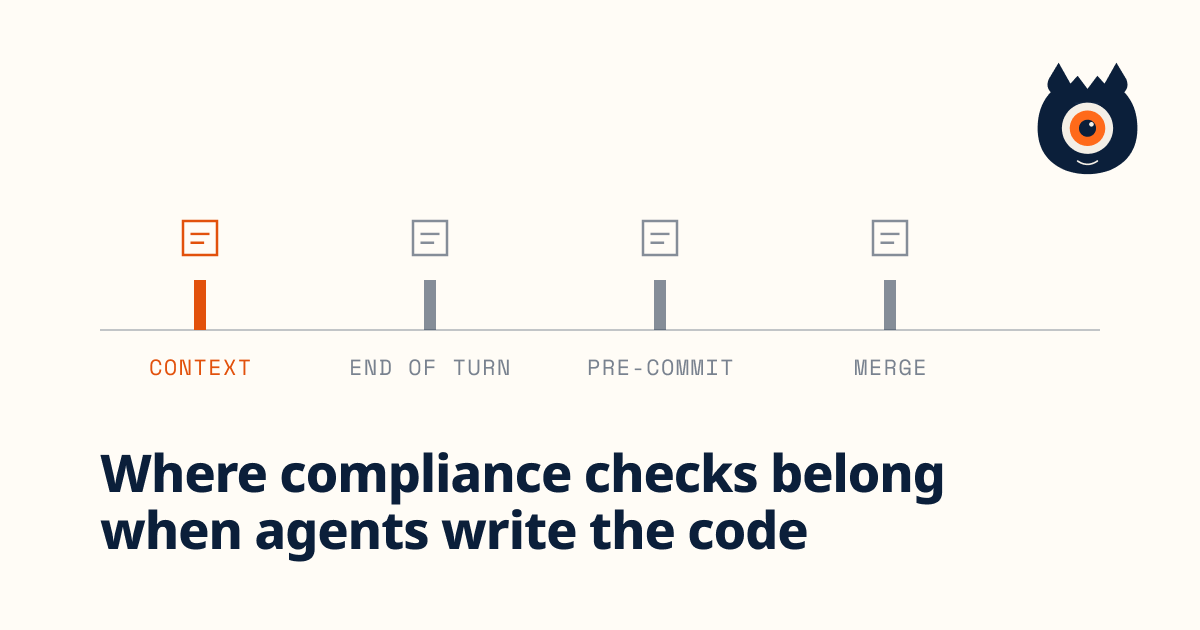
TL;DR: Coding agents now write much of the code that reaches a repository, and a check that waits for the merge finds problems after the agent has moved on. Here is where compliance checks belong when agents write the code, and how Earnie applies one policy at each step.
Most developers now use coding agents every week
Nine in ten professional developers now use AI coding agents at work every week. The figure comes from JetBrains' Developer Ecosystem Survey 2026, which covered more than 15,000 professional developers: between May and July 2026, 90% were using AI coding agents at least weekly, and 68% were using them daily.
Those numbers count people and how often they reach for an agent. Put them next to the way agents work, proposing whole changes that a developer accepts, often in bulk, and a large and growing share of new code starts with an agent.
The developer still owns the commit. What went into it, including which packages to add and which existing code to reproduce, was the agent's call. A compliance process built on the idea that a human wrote each line, and knows where it came from, is now working from the wrong assumption.
End-of-pipeline checks arrive after the agent has moved on
A check that runs at merge time sees a change after it has been written, reviewed and pushed. For a human author that delay is tolerable, because the developer still remembers why a dependency went in. An agent session has usually closed by the time the pull request opens, and its context has gone with it.
Picture the licence or policy finding that turns up at that point. It lands with a developer who didn't choose the component and may not know why the agent did, and a quick fix becomes a small investigation. Repeat that across every agent session in an engineering organisation and it adds up to a steady drain on time that produces no new code.
The merge gate still has a job. It works best as the final check, reached by changes whose problems were mostly caught where they were created.
Compliant from the first prompt means rules before code
Compliant from the first prompt means the agent knows the rules before it writes. If a project disallows a licence, restricts a model or flags an algorithm, that policy belongs in the agent's working context from the start of the session, alongside the coding standard and the test command.
Cost explains why. A problem the agent avoids costs nothing. One caught at the end of the agent's turn costs one more turn, while one caught at merge costs a developer's time, and a problem found after release costs far more.
For an engineering team, the useful question becomes how early the policy can reach whatever is writing the code.
One policy across the agentic development lifecycle
Earnie gives the agent the project's policies, then checks its changes against the same policy at the end of each turn, at pre-commit and at the merge gate.
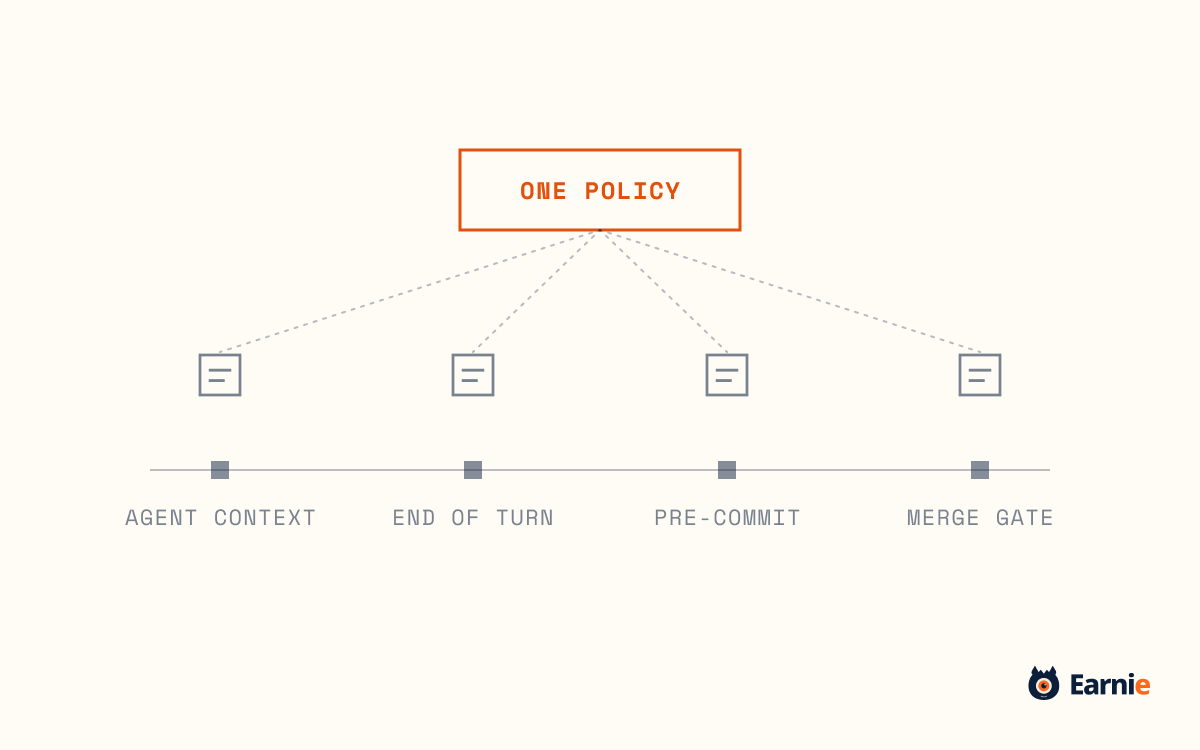
The first is the agent's own context. Earnie's MCP server lets an agent read the policies in force for its project, check code, look up findings and the project's gate, and export a bill of materials. With the Earnie CLI, the project's policies are written as plain rules into the file the agent reads for instructions, so they're already there before it writes anything.
Next comes the end of each turn. For Claude Code, Cursor and Codex with the CLI, a hook sends the agent's changed files for a Self-check at the end of every turn. A Self-check is quick and narrow: it looks only at the files it's given, creates no findings and never changes the project's posture (its overall status). The agent can correct itself without filling the record with noise.
Pre-commit is the third. The same Self-check runs on staged files before anything is committed, whoever wrote them.
The merge gate closes the sequence. It decides whether a change can merge based on the findings the change introduces, and posts that decision on the pull request. Each policy sets what happens when a finding appears (block, warn or require approval), and every decision lands in the audit log.
Regulation expects due diligence on every component
Vulnerability reporting under the Cyber Resilience Act has applied since 11 September 2026, and the regulation becomes fully applicable on 11 December 2027. Under Article 13(5) of the regulation, a manufacturer that integrates components from third parties needs to exercise due diligence so that those components do not compromise the cybersecurity of the product.
The Act draws no line between a component a person chose and one an agent chose, and an auditor reviewing the product has no reason to draw one either. Evidence of due diligence has to cover agent-written code too.
What that evidence must contain for a particular product is a question for its legal and compliance team. Its practical form is easier to describe: a record that shows which policy applied, what was checked and what was decided, for every change.
First changes for engineering leaders
Most organisations already have licence, security and AI-usage rules, and most of those rules live in documents developers read once. Turning them into rules an agent can read comes first, because every later checkpoint depends on it.
Then look at where checks run today. If the first check on an agent's output is the pull request, move one earlier, to the end of the agent's turn or to pre-commit, and keep the merge gate as the final decision. Recording every decision in one place means the evidence a regulator or customer may ask for already exists when they ask.
One question is worth putting to your own team. When an agent adds a component this afternoon, how long before anyone checks it against your policy? Earnie gives agents your policy before they write and checks their work at every step after. See it on your kind of codebase: request a demo.