
Why cryptographic agility is now a software quality requirement
Software that can't change its cryptography won't hold up through the post-quantum transition. That's a quality question.
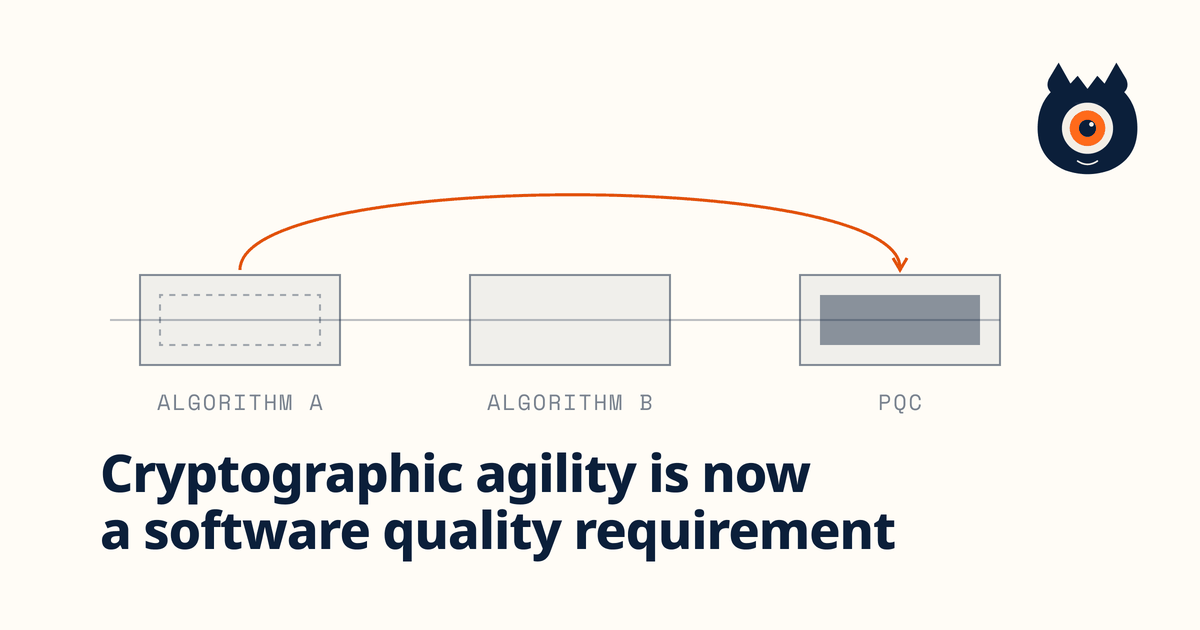
TL;DR: Security is a reflection of engineering quality, and the post-quantum transition makes cryptographic resilience part of that quality. Crypto agility, the ability to switch cryptographic methods, libraries or protocols without tearing apart your infrastructure, is the strategy that lets software keep pace as algorithms change. It starts with knowing what cryptography is in your codebase, where it comes from and whether it is fit for purpose.
Security is often discussed in terms of compliance, risk management, or response planning. These, however, are outcomes, not the origins, of secure design. The presence of robust security mechanisms is more accurately a reflection of engineering quality. In software development, quality is not just about how well something performs when it works, but how well it holds up under scrutiny, pressure, and evolving threats.
As the software industry moves towards higher standards of assurance, particularly around supply chain transparency and cryptographic resilience, it becomes harder to separate quality from security. The two are inherently linked.
As quantum computing moves out of research and into policy discussions, a new layer of this security–quality relationship is being exposed: cryptographic resilience. The concern is straightforward. Most cryptographic algorithms in use today were not designed to withstand quantum decryption techniques, they pose an imminent and increasingly recognised risk to digital infrastructure.
Governments have already started to respond. NIST published its first post-quantum cryptography (PQC) standards in August 2024, and standards bodies are pushing organisations to identify and eventually replace quantum-vulnerable encryption. The transition to PQC is likely to be gradual, but that doesn't make it optional. Software written today may still be in production long after quantum attacks become a reality.
What is crypto agility?
If cryptography were a suit of armour, most organisations would still be wearing battle gear built for wars long past: heavy, trusted, and dangerously outdated. When the enemy changes tactics, from swords to lasers, you don't want to be stuck in steel plate. You want the ability to switch, swiftly and decisively. That ability is what we call crypto agility.
Crypto agility isn't a new algorithm or a single tool. It's the ability to switch cryptographic methods, libraries or protocols without tearing apart your software infrastructure. In essence, it's future-proofing by design.
While quantum-safe cryptography addresses the risks posed by quantum computing, crypto agility is something different. Quantum-safe cryptography is a tactic, a necessary next step, but crypto agility is the strategy that allows you to keep taking those steps, over and over again. Algorithms will evolve. Threats will shift. Crypto agility means your systems are ready to shift with them.
The past has already shown us how critical this is. In 2017, the SHA-1 hashing algorithm was shattered by researchers using nothing more than commercial cloud computing. Those with agile cryptographic systems switched to SHA-256 and other more secure options quickly. Others faced full-blown technical overhauls, incurring both cost and risk. The lesson wasn't just about SHA-1. It was about the need to move, fast, when the ground beneath your encryption shifts.
Why is cryptographic visibility part of software quality?
This underscores how deeply security and quality are intertwined. Cryptographic agility is part of building software that can adapt to a changing threat landscape. But to achieve it, developers and security teams first need to know what cryptography is being used across their codebase, where it comes from, and whether it is fit for purpose.
Many tools built for software composition analysis don't answer those questions. They are focused on licence compliance or known vulnerabilities. That's useful, but incomplete. Without visibility into how encryption is implemented, organisations may be unaware of silent dependencies that pose future risks. This is particularly relevant given that the vast majority of modern software is built on open source components, where transitive dependencies are often deeply nested and difficult to track manually.
Bringing security under the quality umbrella requires better transparency. Not just at the surface level, but deep into the structure of the software: where cryptographic libraries are used, how they are configured, and whether they align with current and future standards.
Where do you start?
Earnie doesn't provide cryptographic primitives or orchestrate migrations, but it helps build the foundation for crypto agility by making hidden dependencies and the cryptography they contain visible. It scans your codebase and detects outdated or vulnerable uses of cryptographic components, whether in your own code or brought in through third-party libraries, so you can locate insecure or obsolete algorithms like hardcoded SHA-1, even when they're deeply buried in open source packages.
This visibility allows you to take informed action, planning remediation efforts and migrations independently, with a clear understanding of your cryptographic risks. Crypto agility, at its core, is about readiness. It's less about predicting the next standard and more about ensuring you're never locked into the last one.
Security is not separate from quality. It is quality. And in the coming years, the ability to build and maintain quantum-safe software will define the leaders in software assurance and trust.