
Earnie
ARTICLELICENCE COMPLIANCE

Detecting undeclared dependencies (SBOMs are not all created equal)

An SBOM built from manifests lists the ingredients someone remembered to declare.
Giuliana Bruni
Marketing Content Specialist
3 min read
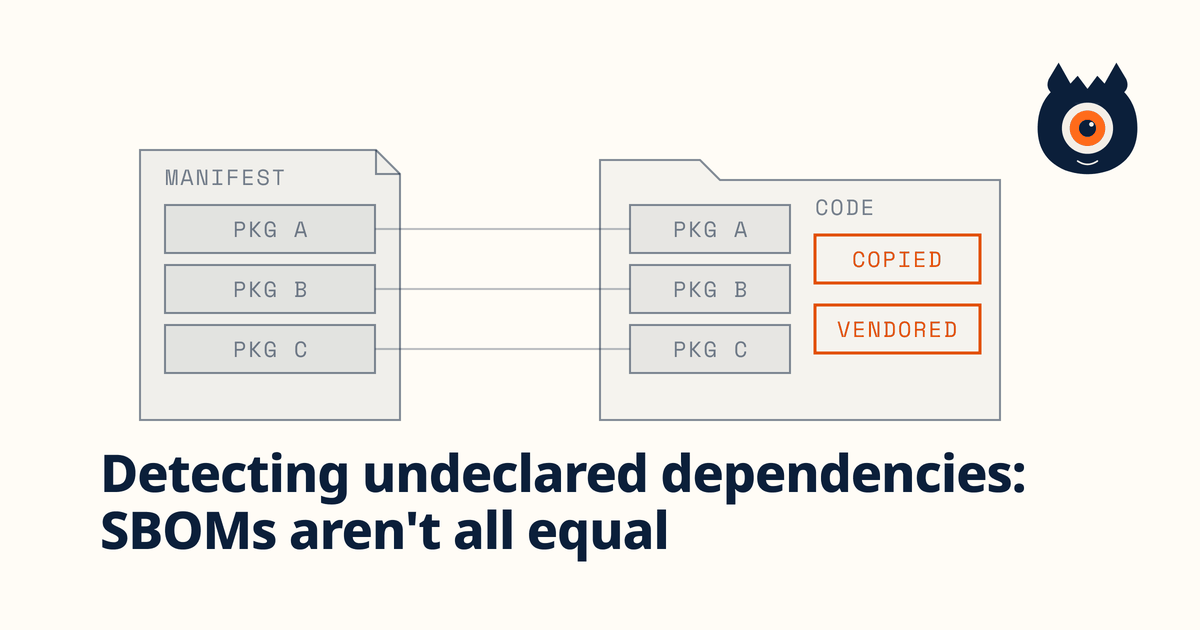
A manifest listing three packages beside the code, which also holds copied and vendored code

TL;DR: Undeclared open source dependencies are components your application relies on but doesn't explicitly acknowledge, often brought in through generative AI or a simple copy-and-paste. They can introduce security vulnerabilities and licensing conflicts without anyone realising. A complete SBOM lists both declared and undeclared dependencies, and automating its generation keeps it accurate as software evolves.

Imagine a food or nutrition label, only to discover later that some of the ingredients used in its recipe were unlisted, untested, and possibly unsafe. This is exactly the challenge that undeclared open source dependencies present in software development. These hidden components, which your application relies on but doesn't explicitly acknowledge, can introduce serious risks, leaving your software vulnerable to security threats, licensing conflicts, and other risks.

In an increasingly complex and interconnected software ecosystem, understanding what's in your code isn't just a best practice: it's a necessity. This is where a complete Software Bill of Materials (SBOM) comes in.

What are undeclared dependencies?

Undeclared dependencies often exist in the shadows of your software, brought in unintentionally through the use of generative AI or a simple copy-and-paste, for example. These hidden components are undocumented but can still play a critical role in your application's functionality. The challenge lies in their invisibility: developers may unknowingly inherit risks, such as security vulnerabilities or incompatible licensing terms, without realising these dependencies are part of their codebase. Understanding these "invisible ingredients" is key to ensuring your software's security, quality, and compliance.

A truly complete SBOM serves as a comprehensive inventory of all open source components, files and even code fragments within a software application and lists both declared and undeclared dependencies. Complete SBOMs provide full visibility allowing developers to identify not just the libraries they have explicitly included but also all other components that may be included.

How do you detect undeclared dependencies?

To effectively detect undeclared dependencies, organisations should prioritise automating SBOM generation using tools capable of detecting undeclared open source, integrating SBOMs into development workflows, educating teams about dependency management, and conducting regular reviews. Automating SBOM creation during the build process ensures accuracy and minimises the risk of overlooking critical open source in their code. Incorporating SBOMs into the development lifecycle guarantees they remain up-to-date as software evolves. Promoting a culture of dependency awareness among development teams is equally crucial for tracking both declared and undeclared dependencies.

Having visibility into your software's open source dependencies is essential in today's complex development landscape. By taking steps to identify undeclared dependencies in addition to declared dependencies, you can reduce risks and streamline development. Earnie fingerprints every file against its open source knowledge base, so the SBOM includes what nobody declared. For more on why this matters in embedded systems, read what lurks beneath.

RELATED READING

See it on your kind of codebase.

Request a demo
Detecting undeclared dependencies: SBOMs aren't all equal
Earnie
ARTICLELICENCE COMPLIANCE

Detecting undeclared dependencies (SBOMs are not all created equal)

An SBOM built from manifests lists the ingredients someone remembered to declare.

Giuliana Bruni
Marketing Content Specialist
3 min read
A manifest listing three packages beside the code, which also holds copied and vendored code

TL;DR: Undeclared open source dependencies are components your application relies on but doesn't explicitly acknowledge, often brought in through generative AI or a simple copy-and-paste. They can introduce security vulnerabilities and licensing conflicts without anyone realising. A complete SBOM lists both declared and undeclared dependencies, and automating its generation keeps it accurate as software evolves.

Imagine a food or nutrition label, only to discover later that some of the ingredients used in its recipe were unlisted, untested, and possibly unsafe. This is exactly the challenge that undeclared open source dependencies present in software development. These hidden components, which your application relies on but doesn't explicitly acknowledge, can introduce serious risks, leaving your software vulnerable to security threats, licensing conflicts, and other risks.

In an increasingly complex and interconnected software ecosystem, understanding what's in your code isn't just a best practice: it's a necessity. This is where a complete Software Bill of Materials (SBOM) comes in.

What are undeclared dependencies?

Undeclared dependencies often exist in the shadows of your software, brought in unintentionally through the use of generative AI or a simple copy-and-paste, for example. These hidden components are undocumented but can still play a critical role in your application's functionality. The challenge lies in their invisibility: developers may unknowingly inherit risks, such as security vulnerabilities or incompatible licensing terms, without realising these dependencies are part of their codebase. Understanding these "invisible ingredients" is key to ensuring your software's security, quality, and compliance.

A truly complete SBOM serves as a comprehensive inventory of all open source components, files and even code fragments within a software application and lists both declared and undeclared dependencies. Complete SBOMs provide full visibility allowing developers to identify not just the libraries they have explicitly included but also all other components that may be included.

How do you detect undeclared dependencies?

To effectively detect undeclared dependencies, organisations should prioritise automating SBOM generation using tools capable of detecting undeclared open source, integrating SBOMs into development workflows, educating teams about dependency management, and conducting regular reviews. Automating SBOM creation during the build process ensures accuracy and minimises the risk of overlooking critical open source in their code. Incorporating SBOMs into the development lifecycle guarantees they remain up-to-date as software evolves. Promoting a culture of dependency awareness among development teams is equally crucial for tracking both declared and undeclared dependencies.

Having visibility into your software's open source dependencies is essential in today's complex development landscape. By taking steps to identify undeclared dependencies in addition to declared dependencies, you can reduce risks and streamline development. Earnie fingerprints every file against its open source knowledge base, so the SBOM includes what nobody declared. For more on why this matters in embedded systems, read what lurks beneath.

RELATED READING
ARTICLE · REGULATIONS
What lurks beneath: the risk of hidden open source
ARTICLE · LICENCE COMPLIANCE
Licence gates for pasted code

See it on your kind of codebase.

Request a demo