
How to future-proof your encryption landscape in banking systems
DORA made cryptographic control a regulatory requirement for EU financial entities. Quantum timelines add a deadline.
TL;DR: The Digital Operational Resilience Act (DORA) has applied since January 2025 and requires EU financial entities to control their ICT, including cryptographic dependencies in third-party and open source software. Quantum timelines add pressure, with the UK NCSC asking critical sectors to complete discovery by 2028. Banks that succeed will be able to detect, switch and prove their cryptography, and demand the same from suppliers.
The introduction of the Digital Operational Resilience Act (DORA) has transformed how banks are expected to manage encryption. As of January 2025, all financial entities operating in the EU, including banks, insurers, payment institutions, and investment firms, must maintain full control over their information and communication technologies. This includes cryptographic dependencies. DORA is a regulation, not a directive, meaning it applies uniformly and directly across Member States.
What does DORA require for encryption?
Historically, banks addressed operational risks through capital reserves and technical controls. But that model never fully accounted for all ICT risk, especially not the kind introduced by cryptographic libraries buried in third party software, cloud service providers, or open source components. DORA now explicitly requires financial institutions to document, test, and manage the encryption used across their digital systems. That includes not only internal software, but also cryptography deployed by third-party providers.
The regulation's five core pillars include ICT risk management, digital operational resilience testing, incident response, third-party risk oversight, and threat intelligence sharing. Encryption sits at the heart of three of them. DORA's regulatory technical standards on ICT risk management (Delegated Regulation (EU) 2024/1774) require banks to implement specific controls for encryption at rest and in transit, cryptographic key management across the key lifecycle, and updating cryptographic technology in line with developments in cryptanalysis. Regular penetration testing, including threat-led red teaming, is mandatory for systemically significant entities.
How does quantum risk change the picture?
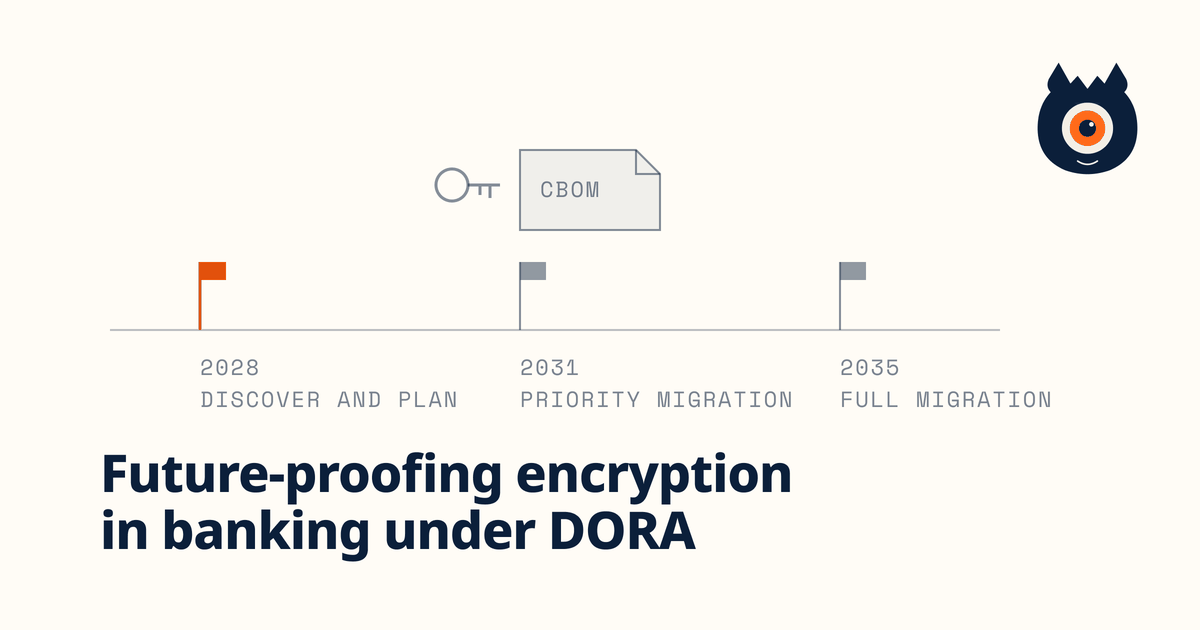
All of this points to an inescapable truth: encryption visibility is now a regulatory mandate. And that's before accounting for quantum risk. The UK's National Cyber Security Centre (NCSC) has published a three-phase migration roadmap, asking critical sectors, including banking, to complete discovery of cryptographic assets and an initial migration plan by 2028, complete high-priority migration by 2031, and complete migration by 2035.
This transition to quantum-readiness depends entirely on cryptographic agility - the capacity to locate, inventory, and swap out encryption libraries and primitives without architectural overhauls. Most banks are not ready, many still rely on outdated algorithms like 3DES and SHA-1 within legacy systems or unmanaged open source transitive dependencies. These are rarely captured in traditional scanning workflows because they are not tied to CVEs or don't trigger known signature matches.
What will set banks apart under DORA?
Banks that succeed under DORA will have comprehensively surfaced all cryptographic usage across their environment: not just the high-profile algorithms supporting customer-facing systems, but also the legacy cryptography buried deep in transitive dependencies, third-party code, and vendor software that "just works" and has gone unchecked for years. The winners will be those who can detect it, switch it, prove it, and demand the same from their suppliers.
Earnie helps banks and financial institutions build real cryptographic agility, with an inventory of every algorithm in the code and a CBOM to prove it.